automated standups
Relay already saw the commits, the PRs, and what merged. It writes the standup from the timeline and posts it where your team reads it. Nobody types a status update, nobody blocks half an hour to say it out loud.

Automate your daily standups.
Automate your daily standups. Relay is the operating system for client work: it sits in the background, watching the tools you already ship with and turning every commit, PR, meeting, and message into a live timeline and a per-project knowledge base, one that answers your clients, feeds your analytics, and powers an AI chat on your own domain. The status update writes itself.
Northwind · storefront rebuild
SHIPPED YESTERDAY
IN REVIEW
WAITING ON YOU
Nobody wrote this. Relay read the repo, the calendar and the thread.
This is the whole product in one artefact: Relay had already seen the commits, the PRs and the call, so the standup was written before anyone would have held it. Sample data, and the shape is the point.
Relay already saw the commits, the PRs, and what merged. It writes the standup from the timeline and posts it where your team reads it. Nobody types a status update, nobody blocks half an hour to say it out loud.
Every commit, PR, meeting, todo, and decision captured against a client and project. “Where are we?” stops being a meeting.
Everything tracked is embedded into a per-project knowledge base, the source of truth. Relay AI answers with citations, scoped in SQL, never in prompts.
The same timeline that writes your standup adds up: throughput, where a project's time actually went, which client is quiet and which is not. Reported, not assembled by hand.
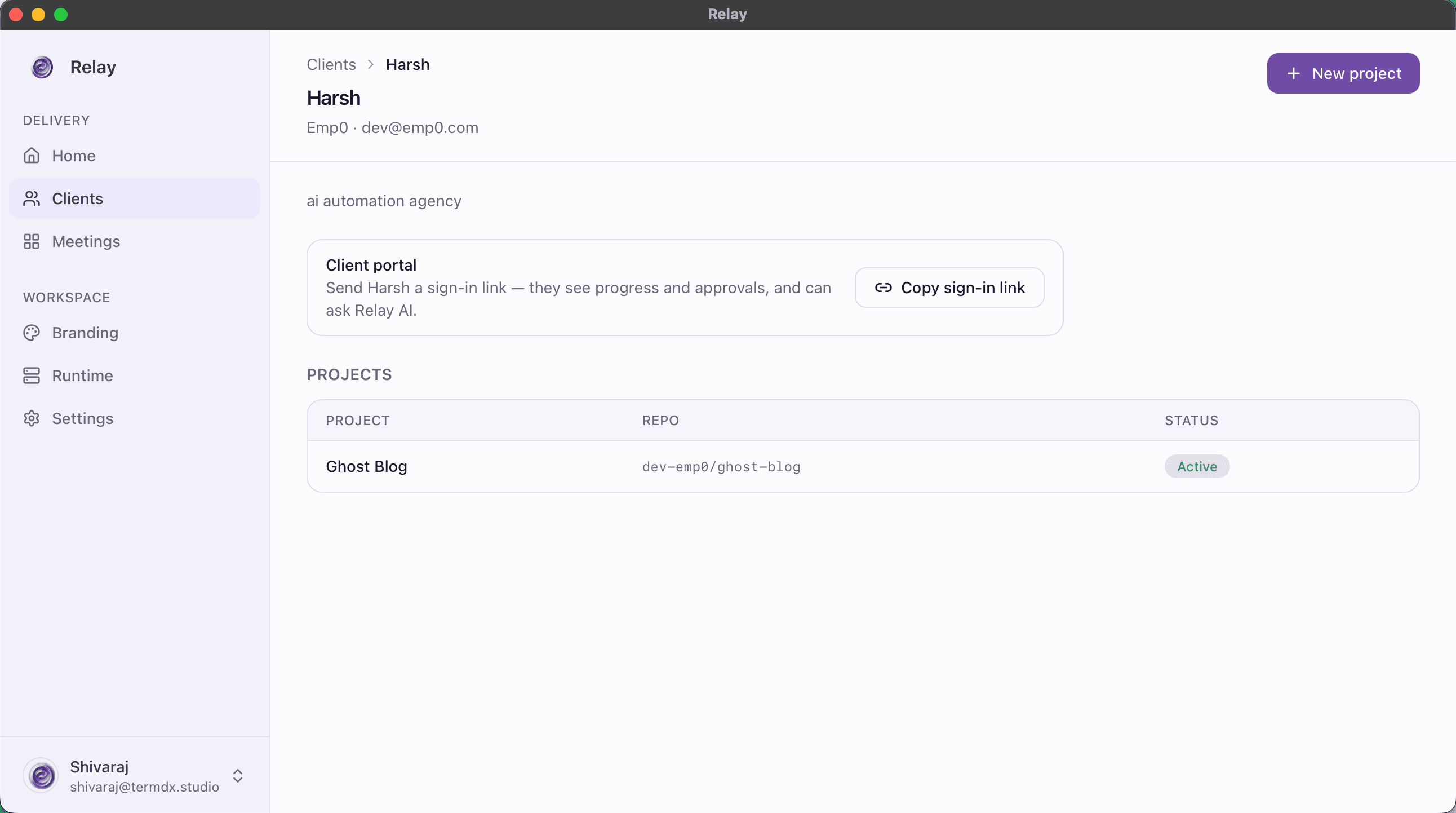
relay.yourcompany.com: your clients see live progress, approve work, and ask Relay AI anything about their project. Your branding, your domain.
Reading runs unattended; writing does not. Issues land on GitHub and emails get sent only after you approve them. That is the one place Relay deliberately keeps a human, and external writes are durable and retried.
GitHub, GitLab, Bitbucket, Slack, Discord, SMTP. Events flow in, notifications flow out, normalized at the edge, never vendor payloads.
Declarative YAML manifests become docker-compose: modules, integrations, encrypted secrets. Your stack, your data, your client's trust.
That is the point. Relay already sees the commits, the PRs, and what merged, so it writes the standup from the timeline and posts it where your team reads it. Nobody types a status update, and nobody blocks half an hour to say it out loud. You read it when you want it.
Yes. Declarative YAML manifests compile to docker-compose (modules, integrations, encrypted secrets), and the whole stack runs on infrastructure you control. Client data never has to leave it.
GitHub, GitLab, Bitbucket, Slack, Discord, and SMTP. Events are normalized at the edge, so the timeline stores Relay's own shape rather than whatever a vendor's webhook happened to send.
It reads on its own and writes only with you. Standups, portal answers, and analytics are generated unattended. None of that touches your tools. Anything that writes back out, like filing an issue or sending an email, waits for your approval and goes through a durable outbox that retries rather than losing the work.
A portal on your domain with your branding: live progress, work waiting on their approval, and a chat with Relay AI that answers from their project's knowledge base, with citations, scoped to their project in SQL.
Relay is commercial software, not open source. You buy a licence and run the stack on your own infrastructure: the source stays ours, the deployment and the client data stay yours.
It's in private beta. Join the waitlist or book a call, and we'll come back to you with access, licensing, and what it costs.
Build notes from Relay as it comes together, plus first word when licences open up.